
How to choose Business Field Number (KBLI) for Foreign Investment in Indonesia

A. What is KBLI (Business Fields Classification)?
KBLI is Indonesia’s Standard Classification of Business Fields, similar to:
- NAICS (North America)
- NACE (EU)
Every business in Indonesia must choose at least one five-digit KBLI code that describes its commercial activity. This code affects:
- Whether your business is open to foreign ownership
- What licenses or permits you need
- The risk level of your business, based on the OSS Risk-Based Approach
2026 Update: As of 18 December 2025, Statistics Indonesia (BPS) enacted BPS Regulation No. 7 of 2025, introducing KBLI 2025 and formally revoking KBLI 2020. KBLI 2025 expands the structure from 21 to 22 categories (A–V) and now covers roughly 1,559 five-digit codes (down from 1,789 in KBLI 2020, following consolidation and splitting of certain business fields). It also adds classifications that didn’t exist before — digital platform intermediation services, Factoryless Goods Producers (FGP), digital content/creator activities (podcasts, gaming, streaming), carbon capture and storage, renewable energy, and crypto-asset related activities.
2026 Update: Transition status: OSS and AHU (the Ministry of Law’s legal entity system) ran KBLI 2020 and KBLI 2025 in parallel during a transition period that officially ended 18 June 2026 — that deadline has now passed. Business licenses (NIB) issued before the transition remain valid, no mass re-registration is required. New PT PMA incorporations and new NIB/OSS filings must use KBLI 2025 from the start. Existing companies only need to update their KBLI code if there’s a substantive change to their business purpose or scope. Some KBLI 2020 codes map one-to-one to KBLI 2025; others split into several new codes (“one-to-many”) or merge from several old codes into one — check the BPS conversion table before filing.
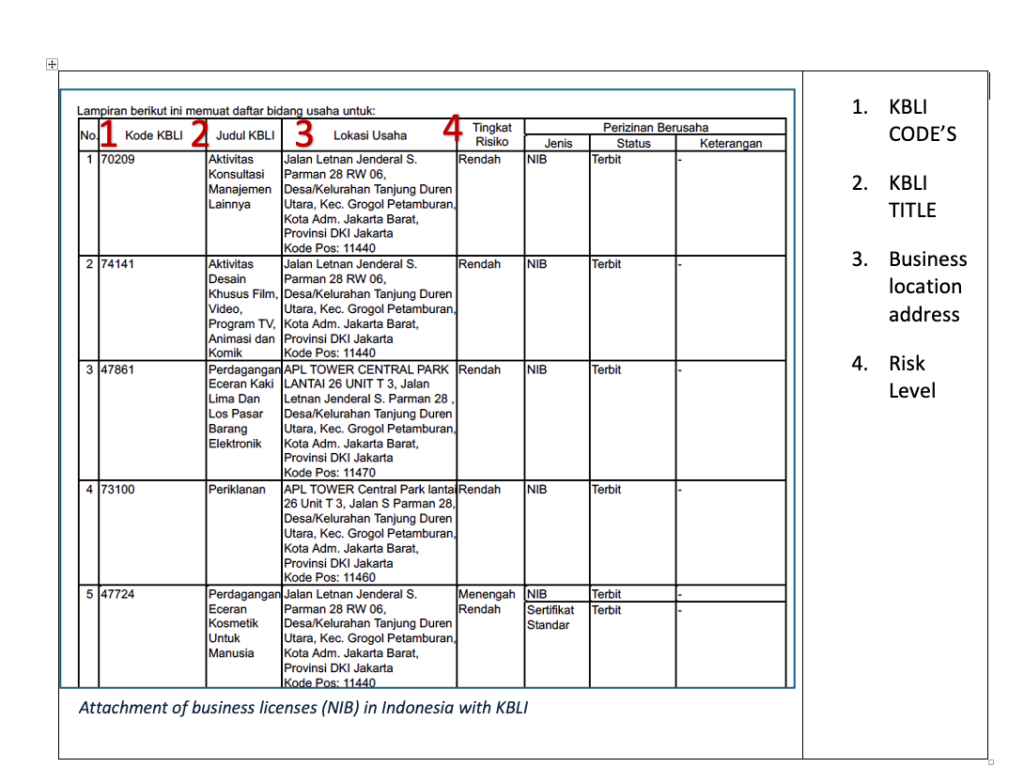
The KBLI details can be found in the attachment to the Business License (NIB). As shown in the example above, item No. 1 indicates the KBLI code held by the company; No. 2 specifies the title associated with the KBLI code used; Column 3 lists the business location address; and No. 4 outlines the risk level associated with that KBLI code—the meaning of which will be explained later in this article.
B. Why is KBLI Important for Foreign Investors?
For domestic investors, KBLI is often treated as a purely administrative matter — just a classification code for statistics and licensing. For foreign investors, however, KBLI serves a far more significant function: it is the legal gateway that determines whether foreign capital is allowed into a specific business field at all.
This is because Indonesia’s investment framework (following the Omnibus Law and Presidential Regulation No. 49/2021) operates on the principle that all business fields are open to foreign investment unless explicitly declared closed or restricted. Whether a field is restricted or not is determined per KBLI code, not by the general industry name. As a result:
- Two companies that both describe themselves as being in “logistics” can face completely different outcomes — one fully open to 100% foreign ownership, the other required to partner with a local shareholder — simply because they selected different five-digit KBLI codes.
- KBLI also determines the business risk level under the OSS Risk-Based Approach (low/medium/high), which in turn determines what type of license is required before operations may begin — an NIB alone, a standard certificate, or a technical permit from a sectoral ministry.
- Because of this, choosing a KBLI code is not simply about finding the closest-sounding description — it is about translating an investor’s actual business model into precise Indonesian legal language, since a single word difference in category can change the legal status of the entire investment.
In short: if a domestic investor picks the wrong KBLI, the consequence is usually a straightforward administrative correction. If a foreign investor picks the wrong KBLI, the investment itself may be legally invalid to operate as planned from the very start.
Example — E-commerce vs Marketplace: A foreign investor from China wants to build an online buy-and-sell platform. If a standard “retail trade” KBLI is selected, the business may become subject to a partnership requirement with local MSMEs under Government Regulation 29/2021. However, if the actual activity is “technology/marketplace platform provision” (rather than selling goods directly), the classification is different and may allow up to 100% foreign ownership. Choosing the wrong KBLI means applying the wrong legal regime entirely.
Example — Freight Forwarding vs General Logistics: A foreign investor wants to operate a freight forwarding business. This KBLI carries a specific foreign ownership cap (commonly up to 67%). If the activity is generalized simply as “logistics services,” initial verification may pass — even though the actual activity (customs clearance, import/export handling) falls under a more tightly restricted category. This creates real risk of a warning or license revocation during a BKPM audit.
Selecting the right KBLI code ensures your business is compliant with foreign investment rules — but compliance is not just about ownership eligibility; it is also about whether the registered business activity actually matches what the company will do day-to-day. These two things are often confused:
- Misclassification happens when an investor selects a KBLI code that sounds similar to their business but technically covers a different scope. This usually occurs because the business model was translated too broadly or too literally, rather than matched against each KBLI code’s official definition.
- The consequences escalate in stages: from automatic rejection during OSS verification (when the system detects a mismatch between supporting documents and the business code), to sectoral licenses being denied at a later stage — even after the NIB has already been issued. This is what most often catches foreign investors off guard: the NIB is issued, they assume everything is settled, but once they apply for technical operational licenses (from Kominfo, the health authority, etc.), the application is rejected because the underlying KBLI was never precise to begin with.
- This issue is especially critical for modern, cross-category business models — such as software-as-a-service, cloud kitchens, or other digital platforms — because their real-world activity often doesn’t map cleanly onto a single KBLI code, making misclassification easy if the investor relies only on the most familiar-sounding label.
Example — SaaS Startup: A foreign investor registers an NIB under KBLI 62010 (Computer Programming Activities), when the actual product is a hosting and data processing service (KBLI 63111/63112). When a technical license is later required for a data center, OSS rejects the application because the registered KBLI scope does not match the actual activity submitted to the Ministry of Communications and Digital Affairs (Kominfo).
Example — Restaurant vs Cloud Kitchen: A foreign investor opens an F&B business on a delivery-only model (a kitchen with no dine-in service). If a standard restaurant KBLI is selected, the investor will be asked for location permits and certifications that are not actually relevant to a cloud-kitchen model — stalling the NIB process because the supporting documents don’t match the registered business code.
Before incorporating a company, foreign investors must carefully match their business activity to the correct KBLI and check its status under the Positive Investment List. This step is critical to avoid legal and operational setbacks — and, since June 2026, it must be done using the KBLI 2025 structure.
Example — PT PMA for an EV Battery Plant: A foreign investor (for example, from Korea) wants to establish a PT PMA manufacturing electric vehicle battery components. Before the deed of establishment is drafted by a notary, the legal team must confirm that the battery-plant KBLI is classified as fully open under the DPI, and that the five-digit code used is a KBLI 2025 code — because since the transition period ended on 18 June 2026, OSS no longer accepts new PT PMA registrations under the old code structure.
Example — Manufacturing Joint Venture: A foreign investor (from Japan) forms a joint venture with a local partner in the precision manufacturing sector. If the KBLI 2020 code used during initial research turns out to fall under a “one-to-many” category in KBLI 2025, the parties must actively select the correct new code — choosing incorrectly could mean the foreign ownership portion that was previously “conditionally open” no longer aligns with the rules under the new code.
C. How to Check Business Fields (KBLI) for Foreign Investment
Step 1: Identify Your Business Activity
Before searching for a KBLI code, it’s crucial to first define your business activity with clarity and precision. This means translating your business model into concrete operational terms that reflect the actual goods or services your company will provide in Indonesia.
Avoid broad or general labels such as “technology” or “consulting.” Instead, break down your activity into specific functions. For example:
- Instead of “Tech company” → define as “Developing and licensing SaaS products”
- Instead of “Retail” → define as “Operating an online platform for fashion accessories”
- Instead of “Logistics” → define as “Providing warehousing and last-mile delivery services”
Step 2: Search for KBLI at the OSS Risk-Based Portal
Use the official OSS Risk-Based Licensing Portal:
OSS Portal: https://oss.go.id/
From the homepage, navigate to: “Information” → “Starting a Business” → “Indonesia Standard Classification of Business Fields (KBLI) 2025.”
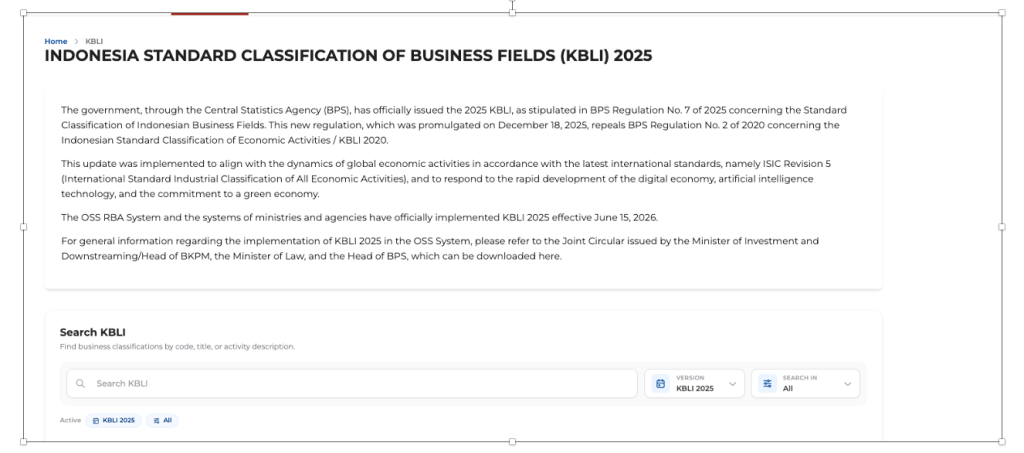
The portal now reflects KBLI 2025 codes. If you’re checking or renewing an old KBLI 2020 code, use the BPS conversion table (released April 2026) to confirm the correct KBLI 2025 equivalent before submitting anything through OSS.
The OSS system and the KBLI portal are only available in Bahasa Indonesia. If you’re a foreign investor, we recommend using:
- Google Chrome’s built-in translator: Right-click → “Translate to English”
- Google Translate Plugin for Chrome or Edge
- Or a local consultant if you want precise guidance
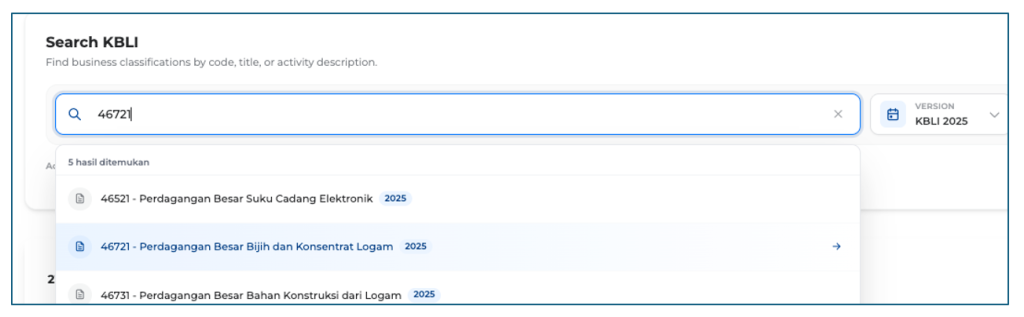
To search, simply type in the business activity you plan to carry out. If you already know the KBLI code, you can enter it directly — for example, if you already know you will be trading metal minerals such as nickel, you can use KBLI code 46721, then click on the KBLI title for a more detailed explanation.
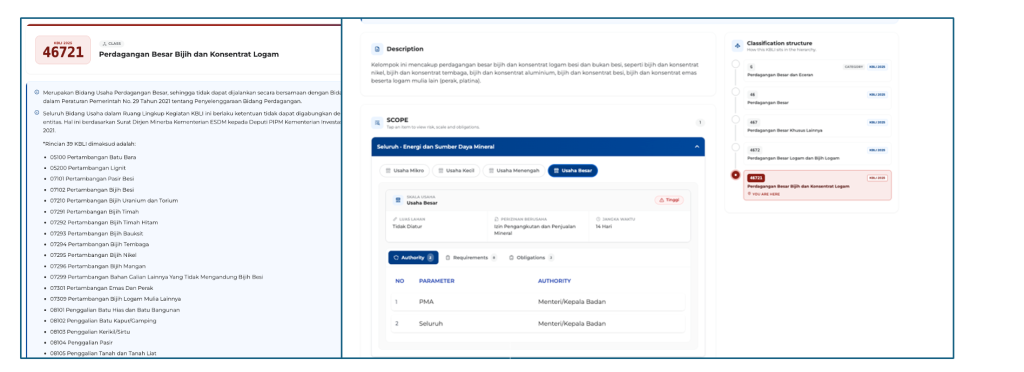
The detailed view displays the restrictions you need to be aware of before selecting this KBLI, as well as whether it can be 100% foreign-owned. It also includes several reference tables: Authority, indicating which ministry or government institution you will need to deal with when starting the business; Requirements, listing the documents needed for this KBLI to become effective before commencing business or production activities; and Obligations, covering the ongoing requirements once the business has started, such as routine reporting or compliance with applicable standards.
C. How to Check Business Fields (KBLI) for Foreign Investment
Step 3: Check the Positive Investment List (DPI)
Indonesia’s Positive Investment List (Daftar Positif Investasi/DPI), issued under Presidential Regulation No. 49/2021, determines whether a specific KBLI code is open to foreign ownership, and if so, under what conditions. This regulation remains in force in 2026; the Ministry of Investment/BKPM issued a follow-up BKPM Regulation in October 2025 that adjusts some application procedures, but the underlying openness/closed classifications under Perpres 49/2021 are unchanged.
Each KBLI will fall into one of the following categories:
Status | Explanation |
Fully Open | Up to 100% foreign ownership allowed |
Conditionally Open | Ownership limited to 49%, 67%, or 70%, or must partner with local shareholders |
Closed | Restricted to domestic investors or state-owned entities |
Step 4: Check Sector-Specific Rules
Although a business activity may be classified under a KBLI code and marked as open to foreign investment, not all activities may commence operations immediately after obtaining a Business Identification Number (NIB). This is due to additional licensing obligations regulated by sectoral ministries or competent authorities, which require fulfillment of technical permits to ensure full regulatory compliance. Each strategic sector in Indonesia is governed by its own set of regulations and procedures for obtaining operational licenses. The table below highlights common sectors and their corresponding authorities:
Sector | Regulatory Authority | Example Regulation |
Energy & Mining | Ministry of Energy and Mineral Resources (ESDM) | Ministerial Regulation No. 10/2023 |
Financial Services | Financial Services Authority (OJK) | OJK Regulation No. 12/POJK.03/2021 |
Manufacturing & Industry | Ministry of Industry | Ministerial Regulation No. 9/2021 |
Once a legal entity in the form of a Foreign Investment Company (PT PMA) has been established and its NIB issued, the company is generally permitted to:
- Open a corporate bank account
- Lease office space or supporting facilities
- Hire employees
- Prepare for business operations
However, the company cannot commence commercial operations until all required sector-specific licenses from the respective technical ministries are obtained. This stage is known within the OSS RBA system as the activation of sectoral business licensing.
Step 5: Verify Business Incentives – Tax Holiday Opportunities
Indonesia provides fiscal incentives to attract investments in priority sectors. One of the most significant benefits is the Tax Holiday, which grants a corporate income tax exemption or reduction for a defined period, applying to companies classified under Pioneer Industries with a minimum capital investment of IDR 100 billion (approximately USD 6.5 million).
2026 Update: The previous tax holiday framework under PMK 130/2020 as amended by PMK 69/2024 expired on 31 December 2025. Corporate income tax incentives, including the tax holiday, are now governed by PP No. 20 of 2026. Companies that submitted their tax holiday proposal to the Ministry of Finance by the 31 December 2025 cut-off under the old rules remain covered by PMK 69/2024; new applications from 2026 onward fall under PP 20/2026.
To verify whether your business qualifies, go to the OSS portal at oss.go.id:
- Open the “Informations” section from the top menu
- Then select “Business Facilities” and navigate to “Tax Holiday”
- Input your target KBLI code (KBLI 2025) to see eligibility
- If it is listed as part of a Pioneer Industry, the portal provides comprehensive details, including product scope and eligibility
For example, KBLI 29300 (motor vehicle component manufacturing) and 30912 (battery industry for electric vehicles) are listed as qualifying business fields under prior classifications — confirm the equivalent KBLI 2025 code via the conversion table before relying on it for a new application.
Selecting the correct business field (KBLI) is more than just an administrative requirement — it is the foundation of a compliant and sustainable investment in Indonesia. A misstep in classification, or relying on the now-superseded KBLI 2020 structure, can cause delays, licensing issues, or even limit your ability to operate effectively. With Indonesia’s regulatory framework becoming increasingly detailed and risk-based — and now transitioning fully to KBLI 2025 — having the right guidance is essential.
At MyLegal Indonesia, we combine legal expertise with practical experience to help foreign investors navigate these complexities and determine the most suitable business fields for their operations under the new KBLI 2025 framework. Our knowledge ensures that your investment is structured correctly from the start, saving time and minimizing risk.
To make this process easier, MyLegal Indonesia has prepared the full KBLI 2025 reference document — translated into English, Chinese (Simplified), Korean, and Japanese — so foreign investors and their teams can review the complete classification in their own language before filing. You can download the version that suits you below.
LINK DOWNLOAD KBLI

MyLegal is to provide professional services for environmental and industrial permitting, mining, and legal affairs in Indonesia. The company specializes in helping clients obtain permits and comply with regulations related to environmental protection, mining operations, and other industrial activities.
- HEADQUARTER
- APL Tower, West Jakarta
- +628-9411-3479
- info@mylegalindonesia.com
- Office Hours: 8AM - 11PM
contact us


- CONTACT INFO
- NEWSLETTER
Subscribe to update news from us